It's a stressful moment: the power's out or the opener's dead, you pull the red cord, and the door still won't budge. Here's the thing most people don't realize: if the door won't move with the opener disconnected, the opener was never the problem. The problem is the door itself, and there's a clear line between what's safe to try and when to stop.
The short answer
If your garage door won't open manually, try the emergency release cord once, properly. Pull it down firmly with the door fully closed, then lift from the center. If the door feels like dead weight or won't move at all, the likely culprit is a broken spring or a jam, and forcing it risks injury or more damage. Stop and call a pro.
How the red emergency cord actually works
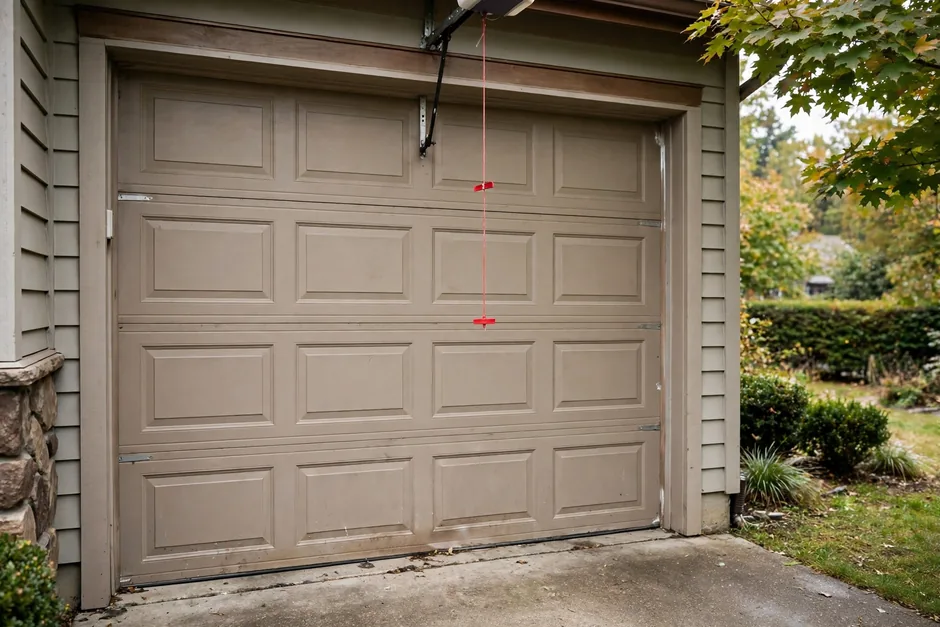
The red cord hangs from the opener's trolley, the sliding piece that connects the opener to the door. Pulling it down disengages the trolley so the door moves freely by hand. A lot of people yank it sideways or while the door is half open, and then wonder why nothing changed. The reliable method: make sure the door is fully closed, pull the cord straight down firmly until you feel it release, then lift the door from the center handle. To re-engage, pull the cord toward the opener motor, then run the opener; the trolley clicks back into place on its own. If it doesn't catch after a cycle or two, the trolley or rail may need attention.
Safe steps to try, in order
- Confirm the door is fully closed. Releasing the trolley with the door half open can let it slam down under its own weight.
- Pull the release cord down firmly. One solid pull, straight down, not a yank at an angle.
- Lift from the center. Grip the handle or the bottom section's center and lift smoothly, keeping your back straight.
- If it moves, look for the cause. Check for a tripped breaker, a manual slide lock engaged on older doors, or ice along the bottom seal in winter.
- If it won't move, or it slams down, stop. That's a mechanical failure, not an opener problem.
Stop immediately if you see this
- The door crashes down when you lift it. A spring is broken. Let it down gently if you can, then leave it alone.
- Cables hanging loose. Lift cables under tension are dangerous. Don't touch them.
- The door is crooked in the frame. It's off track or a spring failed on one side. Forcing it makes everything worse.
- Loud grinding from the spring area. Something is binding or breaking. Stop.
Why it happens
Nine times out of ten, a door that won't budge manually has a broken torsion spring. The spring does the heavy lifting; without it, you're holding the door's full weight, typically 150 to 200-plus pounds for a double door. Other causes: a manual slide lock engaged on an older door (check both sides near the track), the bottom seal frozen to the driveway after an ice storm, or a bent track jamming the rollers. Our spring replacement service handles the most common cause, and if the door is truly stuck, our emergency service covers exactly this situation.
| What you notice | Likely cause | Next step |
|---|---|---|
| Door won't budge, feels like dead weight | Broken spring | Stop, call a pro |
| Cord pulls but nothing releases | Trolley jammed or cord misused | Try once more with door closed |
| Door lifts an inch then stops hard | Manual lock engaged or frozen seal | Check locks and ice |
| Door crooked, cable loose | Off track or cable failure | Stop, call a pro |
Related reading
- Broken garage door spring replacement: the most common reason a door won't move.
- Emergency garage door service: when the door is stuck open or shut right now.
- Why garage door springs break in cold weather: the seasonal pattern behind most failures.
Clarksville Garage Door Rescue gets stuck doors moving across Woodlawn and all of Montgomery County, and the Door & Access Systems Manufacturers Association publishes safety guidance worth a read before you touch anything under tension.