Springs are the hardest-working part of your garage door and the one most homeowners never think about until the loud bang. The good news: their lifespan is predictable. Once you know the cycle rating and your household's usage, you can usually see a failure coming and plan for it instead of being surprised.
The short answer
Most standard torsion springs are rated for about 10,000 open-close cycles, which works out to roughly 7 to 12 years for a typical household. Heavy daily use, rust from our humid summers, and January cold snaps all shorten that. When they go, replace both springs as a matched pair.
What a 'cycle' actually means
One cycle is one full open and one full close. A household that uses the door twice a day runs about 1,460 cycles a year, so a 10,000-cycle spring lasts close to seven years at four cycles a day. Families with teenagers coming and going, home businesses with deliveries, or anyone who uses the garage as the main entrance can easily hit six or more cycles daily, which cuts spring life to four or five years. Count your household's real usage and the math gets honest fast.
| Daily use | Expected spring life |
|---|---|
| 2 cycles a day | 12 or more years |
| 4 cycles a day | About 7 years |
| 6 or more cycles a day | 4 to 5 years |
What wears springs out faster in Clarksville
- Humid summers. Moisture pits spring steel, and pitting creates weak points. Springs in damp garages age faster than the cycle count suggests.
- January cold snaps. Cold makes steel brittle and thickens lubricant. The first hard freeze each year is our busiest week for spring calls.
- Heavy doors. Wood doors and uninsulated double steel doors demand more from their springs every single cycle.
- High-cycle households. Multiple drivers, kids, and home businesses add up. The door doesn't care; the steel keeps count.
- Neglected maintenance. Dry, rusty springs work harder than lubricated ones. A fall lubrication takes five minutes and genuinely helps.
Torsion vs extension spring lifespan
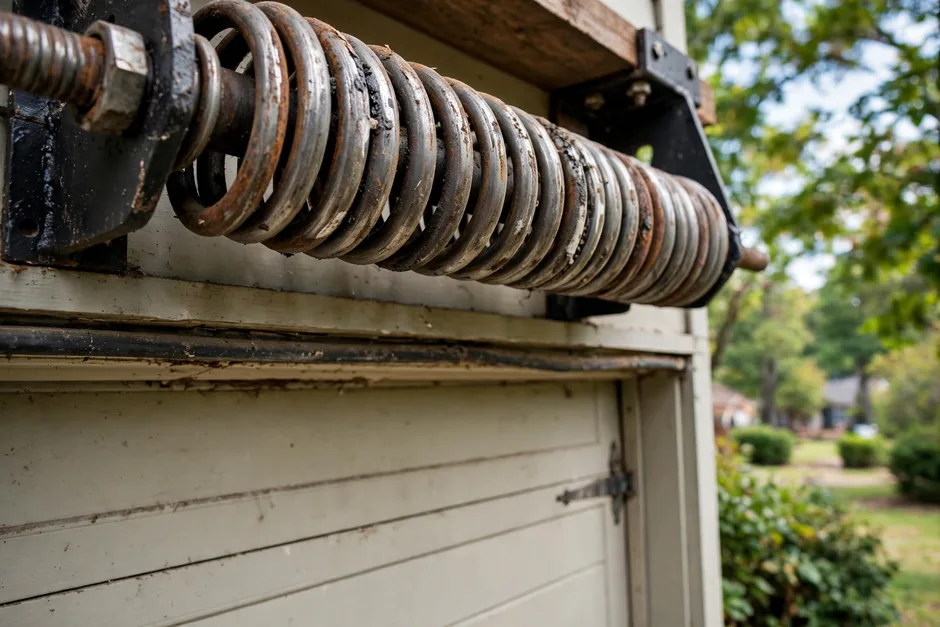
Torsion springs, mounted on a shaft above the door, are the modern standard and typically carry the 10,000-cycle rating. Extension springs stretch along both sides of the tracks on older doors and generally live shorter, harder lives since they're more exposed to the elements. If your door still runs extension springs, make sure safety cables run through them; without cables, a broken extension spring becomes a projectile. When we replace springs, we install matched torsion pairs sized to your door's actual weight, which is why the door feels like new afterward.
Repair vs replace: how to decide
Springs themselves aren't repaired; they're replaced. The real decision is whether to fix just the springs or address the bigger picture. If the door is otherwise solid, spring replacement is the clear call. If the door is 15-plus years old, the cables are fraying, the rollers are shot, and the panels are dented, add it up: when repairs pass half the cost of a new door, replacement is usually the better investment. Our spring replacement service covers the common case, and our cable repair service handles the frayed cables we often find alongside tired springs.
Related reading
- Why garage door springs break in cold weather: the seasonal failure pattern.
- Broken garage door spring replacement: what the service visit includes.
- Garage door maintenance checklist: the routine that stretches spring life.
Clarksville Garage Door Rescue sizes and installs matched spring pairs across St. Bethlehem and Montgomery County, and the Door & Access Systems Manufacturers Association offers industry background on door hardware standards.